How to Measure Higher Education Reputation: A Framework

Measure reputation, understand the signals shaping it, and turn fragmented data into useful intelligence.
If you’ve been around higher ed marketing long enough, you’ve heard this one before:
We should put the money where we can measure the results.
Invest in recruitment marketing. Generate inquiries. Track applications. Measure conversions. Show what the investment produced.
Brand and reputation? Important, of course. But harder to measure and harder to attribute directly to an outcome. So, when budgets get tight, dollars tend to flow toward the things we can more easily prove are working.
The problem is that performance marketing doesn’t start with a blank slate. There is no “Add to Cart” button for a college education. Long before someone fills out a form or makes a donation, something has shaped what they know, believe, and expect about your institution.
Students are making consequential decisions about institutions they cannot fully evaluate beforehand. Reputation helps shape the context in which those decisions are made. Prioritize only the end of that journey because it’s easier to measure, and eventually the pipeline thins.
Google’s Modern Brand Measurement Playbook makes a similar case for looking beyond short-term performance, connecting brand strength, and brand-building activity with marketing effectiveness. We see the same dynamic playing out in higher education.
EducationDynamics’ 2026 Modern Learner Report describes an enrollment journey in which students continually discover, compare, and validate institutions across search, social media, AI, institutional websites, and other sources. The report describes this shift as moving from “static reputation” to “continuous verification.”
For enrollment marketers, that means brand, reputation, and performance marketing aren’t separate stages of the journey. They are working on the same decision at different moments.
And students are only part of the reputation ecosystem.
Reputation shapes how employers view graduates, peers perceive academic strengths, donors see the institution’s direction, communities value its role, journalists assess its credibility, research partners evaluate expertise, and alumni advocate for it.
We’ve become very good at measuring what happens after someone raises their hand. We have been less disciplined about measuring the conditions that helped determine whether they raised it at all.
Those conditions are measurable.
From signals to institutional reputation
My colleague Sarah Russell has written about this changing enrollment environment through EDDY’s work on Signal Engineering, an approach focused on the signals that help institutions become Seen, Trusted, and Chosen by prospective students.
In that learner-centered context, signals across search, AI platforms, social media, paid media, reviews, third-party sources, earned media, and institutional digital properties increasingly work together as students discover, evaluate, and validate their choices.
Brand and reputation intelligence takes a broader institutional view, examining what those signals, along with other reputation evidence, tell us about an institution’s visibility, authority, narrative, trust, and impact across the audiences it needs to influence.
Different audiences encounter different signals, but the underlying question is similar:
How do we know whether those signals are strengthening institutional reputation?
That’s where brand and reputation measurement comes in.
A framework for making reputation measurable
Higher education isn’t suffering from a shortage of data.
Media coverage, search data, surveys, rankings, reviews, social analytics, sentiment measures, website analytics, and competitive intelligence may already exist across the institution. The problem is that they were built to answer different questions.
Once institutions decide to measure reputation, there is also a natural temptation to measure absolutely everything.
I’ve seen this movie before. It ends with 87 metrics and six people pretending they looked at all of them, and randomly, the butler did it.
The better starting point is strategic:
- What are we trying to be known for?
- By whom?
- Is it distinctive and relevant to them?
- Why does it matter?
At EDDY, we’ve developed a Brand & Reputation Intelligence Framework that organizes reputation measurement around five connected dimensions: Visibility, Authority, Narrative, Trust, and Impact.
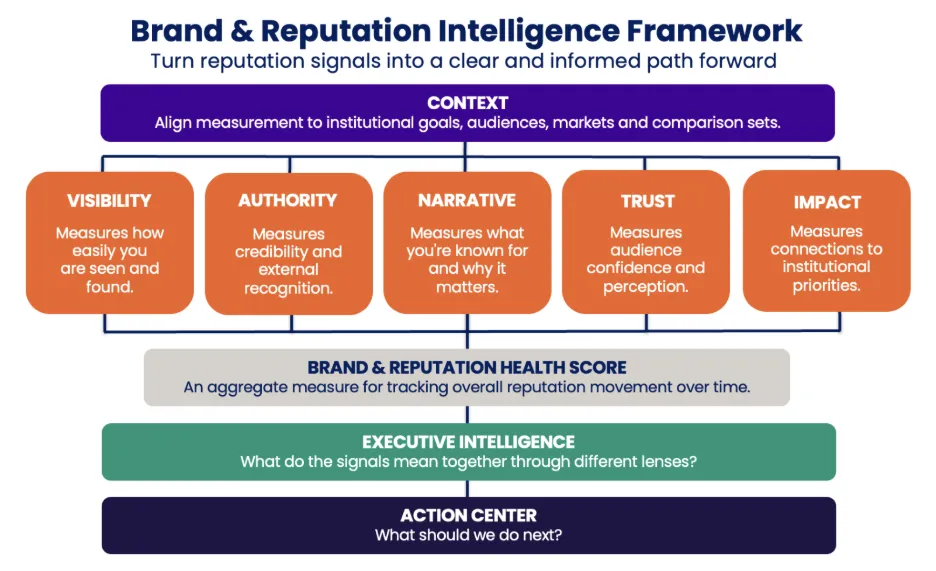
How the five dimensions work
Visibility: Are you being seen and found?
Representative measures: Search visibility | AI discoverability | Media visibility | Social visibility | Audience reach | Branded search demand
You cannot build a reputation with an audience that rarely encounters you.
Visibility examines whether an institution is being seen and found across the environments that shape awareness and discovery. That includes being discoverable when someone is actively looking for an institution, program, expert, or answer, as well as appearing in media, social platforms, and other environments where audiences may encounter the institution without searching for it.
Visibility doesn’t tell you what people think. It tells you whether you have an opportunity to shape what they think.
Authority: Are you recognized as credible?
Representative measures: Expert mentions | External citations | Authoritative links and references | Research and faculty visibility | Search and AI representation
Being visible is not the same as being authoritative.
Are your experts being quoted and cited? Are faculty and research appearing in relevant external conversations? Do credible sources reference the institution? Is information about it accurate and consistent across search and AI?
After all, there are only so many times you can tell people you’re exceptional before they start wondering who else agrees.
Authority looks for evidence that credibility and recognition extend beyond the institution’s own channels. That matters because audiences increasingly encounter institutions through media, rankings, reviews, search, social conversations, AI-generated responses, and other third parties.
Narrative: Are you known for something distinctive and relevant?
Representative measures: Priority-message presence | Distinctive brand associations | Audience relevance | Narrative share of voice | Competitive differentiation | External topic associations
Most institutions have no shortage of stories. The harder question is whether those stories are creating associations that are distinctive, relevant to priority audiences, and connected to institutional strategy.
A university seeking a stronger reputation for research excellence can count the research stories it publishes. That’s an activity metric.
Reputation measurement asks different questions. Are external audiences increasingly associating the institution with research excellence? Are faculty experts connected with topics the institution wants to own? Does that association matter to priority audiences? Is the institution becoming more distinctive from relevant competitors?
Publishing the story is not the same as owning the narrative. And owning a narrative that doesn’t matter to your audience isn’t much better.
Brand strategy defines the position an institution wants to occupy and why it matters. Narrative measurement helps determine whether those desired associations are actually taking hold.
Trust: Do audiences believe you?
Representative measures: Audience perception | Media sentiment | Social sentiment | Reviews and ratings | Emerging issue trends
Visibility, authority, and distinction only get you so far. People also have to believe what they encounter.
Trust can be examined through audience research, sentiment trends, reviews, social conversation, and emerging issues. But a favorable sentiment score or survey result means little without context: who is responding, what is being measured, how has it changed, and how does it compare?
And trust is not created solely through communications.
Communications can amplify strengths. They cannot permanently compensate for an experience that contradicts the story.
Measurement can help determine whether institutional claims are being reinforced or contradicted by what audiences encounter elsewhere.
Impact: Is reputation contributing to institutional priorities?
Representative measures: Inquiry and application behavior | Enrollment | Digital engagement | Advancement engagement | Peer perception | External recognition
Eventually, reputation measurement has to connect to outcomes leaders care about.
For enrollment, that might mean examining whether changes in visibility, authority, narrative, or trust coincide with branded search, inquiries, and applications. Elsewhere, relevant outcomes might include donor and alumni engagement, peer perception, research partnerships, or external recognition.
For enrollment leaders, this is also where reputation intelligence can help illuminate the conditions influencing whether prospective students move from being Seen and Trusted, toward being Chosen.
But the word contributing matters.
An increase in reputation indicators alongside enrollment, fundraising, or engagement does not prove that reputation caused the change. Impact measurement looks for relationships, patterns, and movement over time rather than claiming attribution the evidence cannot support.
From five dimensions to a reputation health score
The five dimensions can roll into a broader Brand & Reputation Health Score, giving leaders a simpler way to track overall movement over time.
But getting from dozens of reputation measures to a meaningful score requires more than arithmetic. Search visibility, brand associations, share of voice, reviews, sentiment, and survey results all use different scales.
You can’t simply add them together and call the result a reputation score.
Well, you can. You just shouldn’t.
A disciplined framework normalizes those measures so unlike signals can be interpreted together.
In simple terms, normalization puts unlike measures into a common frame of reference so they can be meaningfully compared.
But normalization alone isn’t enough. A small independent college, a regional public university, and an R1 research institution operate in different markets, with different audiences, competitors, and ambitions.
Comparing yourself with Harvard may make for an interesting afternoon. It does not necessarily make for useful intelligence.
Good reputation measurement requires the right measures, baseline, comparison set, geography, audiences, and institutional goals.
Greater visibility isn’t necessarily progress if you’re becoming known for the wrong thing. Strong narrative ownership isn’t particularly valuable if the narrative doesn’t distinguish you or matter to priority audiences. And greater awareness isn’t enough if audiences don’t trust what they find.
That’s why the dimensions need to be interpreted together.
Measurement also requires humility about attribution. If reputation indicators improve while enrollment increases, that doesn’t prove one caused the other. The goal is to track movement, identify patterns, and understand how reputation indicators relate to institutional outcomes over time.
The result is not a perfect measure of reputation. Nor should it pretend to be. It is a disciplined way to establish a baseline, monitor change, and identify where leaders should look more closely.
Because the score isn’t really the point.
Measurement is the beginning, not the destination
A reputation health score can tell leaders where something is strengthening, weakening, or holding steady. The dimensions underneath it can reveal which measures are driving that movement.
But measurement alone isn’t intelligence.
Knowing that visibility increased, trust declined, or a distinctive narrative gained traction tells you what changed. It doesn’t automatically tell you why it changed, whether it matters, how different measures relate to one another, or what the institution should do next.
Those questions require context, interpretation, and prioritization. The same reputation data can tell very different stories when viewed through enrollment, research, rankings, advancement, AI visibility, or strategic communications.
That’s where reputation measurement becomes reputation intelligence.
For enrollment leaders, that intelligence can help explain the signals influencing whether prospective students see, trust, and ultimately choose an institution. For institutional leaders, the same measurement system can address broader questions about research reputation, advancement, rankings, public visibility, competitive position, and institutional standing.
In the next article, we’ll look at how to move from individual measures to intelligence, apply different strategic lenses to understand what the data means, and determine which opportunities and vulnerabilities deserve action.
If reputation matters enough to invest in, it matters enough to measure.