A Mandate for Transformation: Inside the 2026 Marketing and Enrollment Management Benchmarks

For too long, institutions have operated under an enrollment model built for a market that no longer exists. That status quo persists because it benefits entrenched service providers who profit from preserving the illusion that yesterday’s playbook will solve tomorrow’s challenges. These models feel safe, but they quietly divert resources away from the work of real institutional evolution.
At EducationDynamics, we reject that approach. We refuse to manage a legacy of decline. We are actively dismantling the traditional enrollment playbook to meet a new reality defined by rapid AI advancement, fundamental shifts in student behavior and a growing demand for data-driven action.
The 2026 Marketing and Enrollment Management Benchmarks is more than a collection of data. It is a strategic blueprint for institutions willing to challenge convention. Traditional benchmarks act like a rearview mirror. These benchmarks define the road ahead, focusing on the forces now driving growth: brand authority, AI visibility, intent-rich audiences, operational speed and measurable value.
The Forces Defining Higher Ed in 2026
These trends are not incremental adjustments or cosmetic shifts. They represent a structural reset in how students discover institutions, how trust is earned and how enrollment engines generate growth. Together, they form the pillars of survival for institutions that intend to compete in the next decade, not merely endure it.
1. High-Value Branding
Winning institutions treat brand equity and transparency as primary drivers of top-of-funnel performance. In an era of automated information, trust is the only currency that matters. Reputation is the new SEO. If students don’t trust you, they never search for you.
By 2025, nearly 60% of online learners started their journey by searching for a specific institution—a 354% increase in brand-first searches since 2015. The funnel is no longer program-first. Your brand is the search term. If students don’t already believe in your value, you may never enter their consideration set.
This shift makes it clear: reputation, trust and visibility now shape the top of the enrollment funnel more than any single program. Institutions that invest in brand equity, AI-ready SEO and consistent messaging across channels are the ones that show up first when learners start their search.
Visibility is no longer earned by keywords alone; it is earned with reputation, authenticity and authority—especially in AI-driven environments:
- Generative Engine Optimization (GEO): Structure proprietary data so your institution is cited as a trusted source by large language models.
- Answer Engine Optimization (AEO): Provide concise, factual responses to zero-click queries so AI surfaces your brand as the answer.
- AI Density: Measure how often your institution appears as a cited source within AI ecosystems, your new visibility metric in a Search Everywhere world.
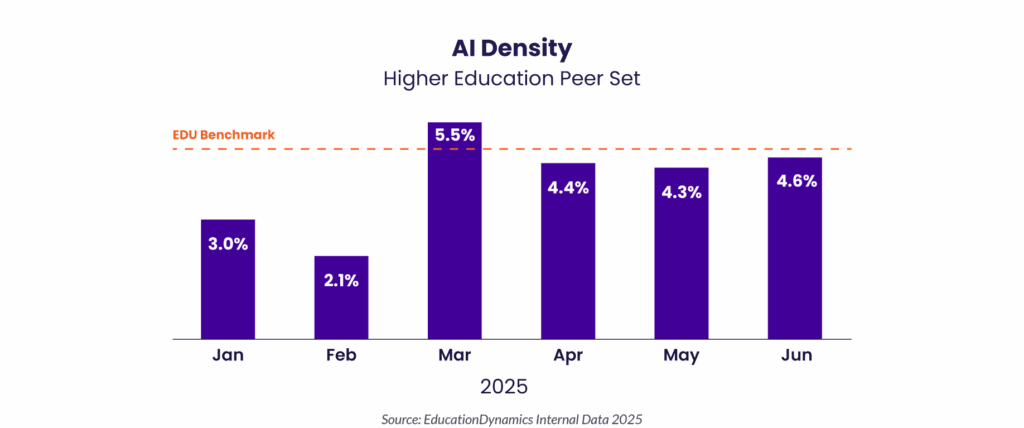
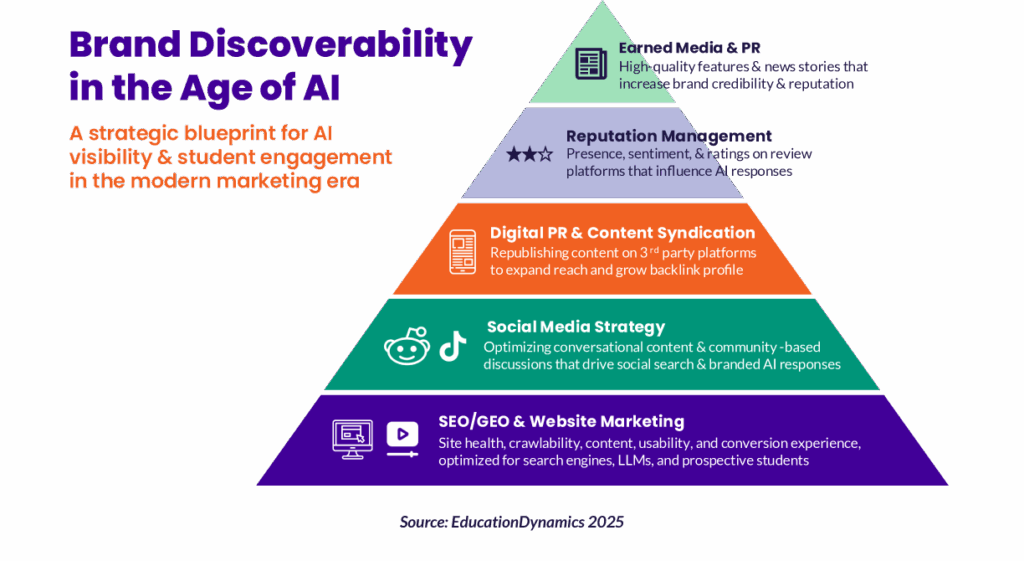
The report introduces the AI Visibility Pyramid, a strategic framework that connects brand reputation, content, reviews and earned media into one system designed to make your institution the trusted answer inside AI ecosystems—not just another result if someone happens to click.
2. “Search Everywhere” Transformation
The traditional search results page is disappearing. It is being replaced by conversational AI and a multi-platform ecosystem where students demand answers, not links. Visibility is now a conversation, not a click.
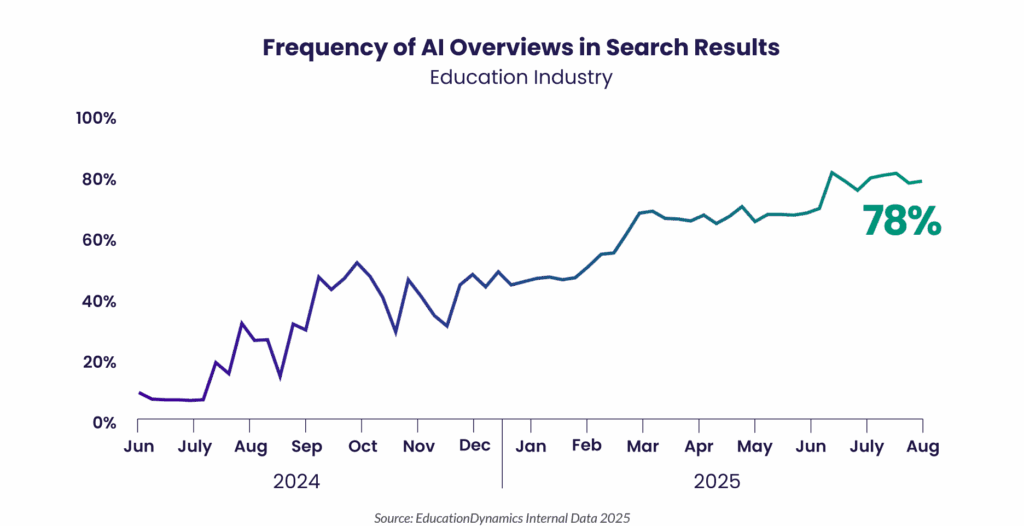
An estimated 78% of education-related searches now return an AI Overview, and nearly 45% of Google searches end without a click. Students are building shortlists and making decisions from AI overviews, chatbots, social feeds and video long before your institution’s website loads. If your brand isn’t present in these AI-driven answers, you’ve lost the conversation before you see the prospect.
3.The Efficiency Imperative
Cost inflation is no longer a future concern. It is the operating reality for higher education marketing. In 2025, total digital media spend surpassed $2.77 billion, yet rising costs failed to produce proportional performance gains.
Efficiency across traditional acquisition channels has eroded. Non-brand paid search CPCs climbed 30.9% year over year, increasing the cost of competing on generic, high-intent keywords. That pressure is amplified by zero-click search behavior, which continues to weaken keyword-driven volume strategies.
In this environment, efficiency is not a budgeting exercise. It is a competitive advantage. Institutions outperforming the market are using AI-driven attribution models to understand how organic, paid, and brand touchpoints actually influence enrollment. The focus shifts from chasing clicks to identifying high-intent learners earlier and engaging them with precision.
The Efficiency Imperative is about where and how institutions invest. In 2026, growth will favor those who deploy capital intelligently, align messaging to intent, and reach the right learner at the decisive moment.
4. Value Outperforms Volume
Inquiry volume once signaled success. In 2026, it signals inefficiency. High volumes of low-intent leads inflate costs, overwhelm admissions teams, and obscure real demand.
Institutions can no longer rely on inquiry-driven attribution to understand the market. Many of today’s strongest prospects never raise their hand. Growth now depends on brand authority within AI ecosystems, content structured for conversational search, and predictive models that surface high-intent learners before a form is ever submitted.
The data confirms this shift. Career Changers and Leadership Track learners convert at 9.75% and 15.73%, far outperforming less motivated segments. These learners are decisive, outcome-driven, and ready to act when value and ROI are clear.
At the same time, stealth applicants now account for 9.7% of total applications, up from just 1% in 2020. They research independently, build their own shortlists, and apply when confident, often without entering a traditional funnel.

Institutions that prioritize motivation, fit, and outcomes over raw inquiry counts build smarter funnels that convert faster and operate more efficiently. In 2026, success is defined not by how many leads you generate, but by how many of the right students you enroll.
What this Means for Higher Ed Leaders 2026
Higher education has entered a new era, and the data leaves no room for debate. Modern Learners have rewritten how institutions are discovered, evaluated and chosen.
Institutions that prioritize scale over substance will fall behind in a market defined by AI-driven search, zero-click behavior and value-first decisions. Survival is not the goal. Growth is.
The strategic imperatives that follow are not recommendations. They are the minimum requirements for relevance in 2026 and beyond.
The Strategic Imperatives Higher Ed Leaders Must Prioritize
1. Mechanize Brand Authority for a Zero-Click World
Nearly half of searches now end without a click. Visibility no longer belongs to the best-ranked institutions. It belongs to the most trusted brands. In a zero-click world, institutions must optimize for AI Density, ensuring brand content, outcomes data and FAQs are cited inside AI Overviews, while actively defending brand authority across the decentralized platforms that shape AI answers.
2. Pivot from Lead Volume to Enrollment Value
The era of buying growth through lead volume is over. Rising CPIs have made mediocre leads an expensive distraction. More leads are not the objective. Enrolling the right students is. Success in 2026 requires abandoning vanity metrics and optimizing toward Cost per Application and Cost per Enrollment using first-party data and AI-driven optimization.
3. Engineer Velocity into the Funnel
Modern Learners move fast and reward speed. Most enroll at the first institution that admits them. Delay kills conversion. Institutions must design for velocity at every stage, using AI as a 24/7 admissions concierge to answer questions, engage stealth researchers, and eliminate friction across the funnel.
4. Move from Performative to Operational AI
In 2026, the greatest barrier to progress is not technology, but cultural paralysis. Institutions waiting for a “perfect plan” will end up optimizing a strategy the market has already outgrown. AI cannot live on the sidelines. Leadership must treat it as operational infrastructure, championing upskilling and cross-functional integration across marketing and enrollment. The advantage comes from using AI to drive real-time personalization and faster decisions, not from experimenting in isolation.
Design the Next Era of Higher Education Marketing and Enrollment Management
The 2026 Marketing and Enrollment Management Benchmarks draw a clear line in the sand.
Institutions can continue funding tactics that defend a declining model. Or they can confront the data, challenge long-held assumptions, and build enrollment strategies aligned with how Modern Learners actually search, decide and enroll.
EducationDynamics partners with institutions ready to make that shift.
Download the full 2026 Marketing and Enrollment Management Benchmarks to understand where your strategy stands, where the market is moving and what it will take to compete in what comes next.