SEO Did Not Die at Google I/O. It Just Became Beachfront Property
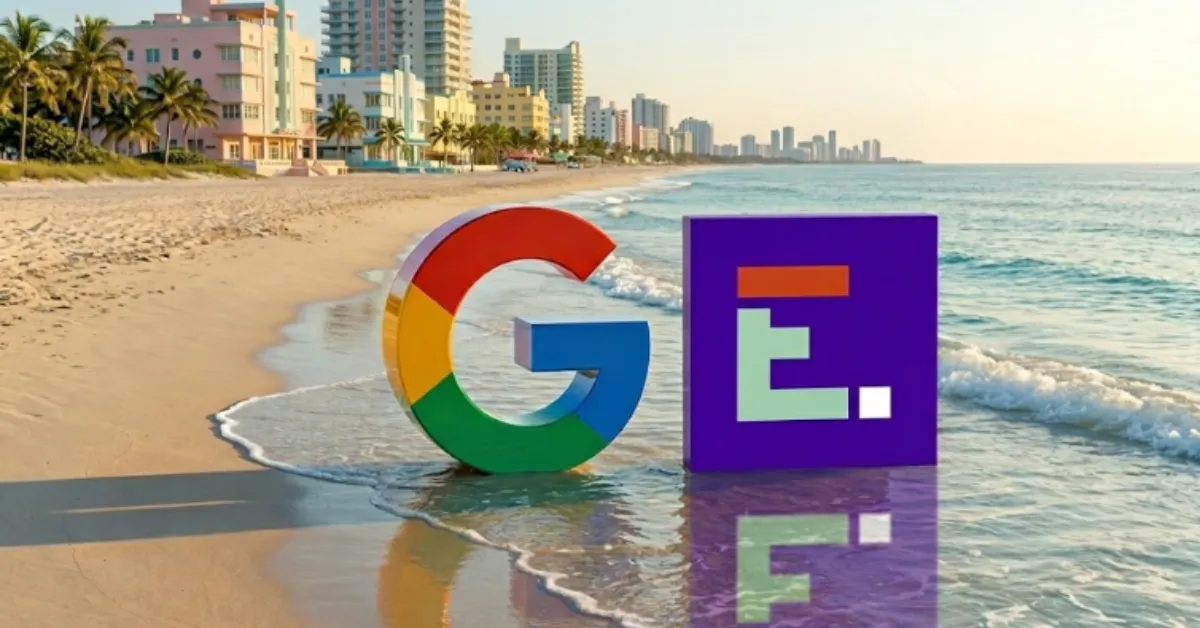
If you read the headlines coming out of Google I/O, you would think Search ended overnight. “Google Search as you know it is over.” “SEO as we know it just ended.” It makes for a great headline. It is also not true.
Here is what actually happened, and why it matters more than the panic suggests.
Traditional Search did not change overnight. The majority of what Google announced has been sprinkled into Search for the past year or more. AI Overviews, conversational AI Mode, ads woven into AI answers. None of it is brand new. Google is simply pushing it harder and packaging it as a milestone. The “ten blue links” of organic SEO are still right there on the page. And Google Ads are more visible than they have ever been.
What Google really did at I/O was take an official step forward to be far more conversational. They want the next level of “Hey Google,” that friendly voice-search feature, to become Gemini following you everywhere and helping with just about everything it can. Be honest about the context: Google was behind in the AI race when ChatGPT and Claude set the pace, and they have been making big, deliberate moves to stand out ever since. This conference was one of those moves.
So no, SEO did not end or die. It got way more important. The once cheap or modest piece of real estate known as SEO is rapidly becoming beachfront property, the kind some businesses are going to find they can no longer afford. The space on the page is shrinking and the value of owning it is climbing.
That changes the job. Marketers have to sharpen their tools and stay laser focused on the elements that matter most, then hand the rest off to automation or let it sit on the back burner. A lot of this is still rolling out through summer 2026 and the space is moving weekly, so we will tell you what is confirmed, flag what is still in flux, and give you our honest read on where to aim your focus.
What Google Actually Announced
The short version: Search is becoming a conversation and an interface, layered on top of the results page you already know rather than replacing it.
A few specific changes stand out.
The search box is now conversational. Instead of typing a few keywords, you can ask longer, more natural questions, and Google drops you into AI-powered interactive experiences rather than a page of ten blue links. AI Overviews, the short AI-generated summaries at the top of results, now reach billions of monthly users, and the conversational AI Mode has crossed a billion as well. This is no longer a fringe feature. It is how a large share of searches already behave.
“Information agents” will search on your behalf. Starting this summer, users can set up agents that work in the background around the clock, tracking changes across the web and alerting them when conditions are met. Think of it as a far smarter version of the old Google Alerts. The important consequence: increasingly, the thing “doing the searching” is an AI agent, not a human scanning results. People will spend more time acting on what the agent surfaces and less time clicking through links themselves.
Generative UI builds custom answers on the fly. Rather than sending you to a website that has a calculator, a comparison, or a visual explainer, Google can now generate that interactive widget directly inside the result. The page you used to click to is increasingly being assembled inside Search itself.
What did NOT change is just as important, and it is worth repeating because the headlines bury it. The blue links are still there. Google Ads are still there, and more prominent than ever. The institutions and businesses that earn attention still get found and chosen. People who want to enroll in a program, request information, or submit an application still complete those actions. The funnel changed shape. The destination did not disappear.
The Honest Read: Fewer Clicks, Higher Stakes
Here is the uncomfortable part, stated plainly. These features are designed to meet a user’s need directly inside Search, without a visit to anyone’s website. For purely informational queries, that means fewer clicks reaching publishers and brands. Early 2026 industry data backs this up: organic click-through rates are down meaningfully on queries where an AI Overview appears, and a large majority of AI Mode searches end without any click to an outside site at all.
That sounds like bad news, and for a content strategy built purely on ranking to capture a click, it is. But it reframes the opportunity rather than closing it. When the AI answers the question, the brand that gets cited inside that answer wins the trust and the awareness, even without the click. And when someone is ready to actually do something, enroll, inquire, apply, they still leave Search to do it. The institutions that struggle will be the ones whose only value was answering a question a machine can now answer for free. The ones that thrive will be genuinely the best choice for the decision that follows.
That is the whole game now. Not marketing yourself as the best fit. Being the best fit, and structuring your presence so the AI recognizes it.
How Higher Education Can Keep Winning Through This Evolution
The goal is enrollment, and prospective students are exactly the people now living inside this new Search. They research programs for months, ask long and personal questions, compare schools obsessively, and increasingly get those answers summarized by AI before they ever land on an institution’s site. For a school with genuine strengths, that is not a threat. It is a filter that rewards the institutions that tell a clear, credible, well-structured story and quietly buries the ones coasting on a name or a brochure.
The institutions that excel from here are not the ones that fight the change. They are the ones that claim the beachfront before the price goes up. And higher ed is actually well positioned for it, because the prospective-student journey is long and high-consideration. The AI can summarize a program, but it cannot make the decision to enroll. That decision still happens on your terms, through your site, your admissions team, and your branded searches. Here is how to excel through it.
Become the source the AI cites for program questions. Students ask things like “is an online MSN worth it,” “what can I do with a public health degree,” and “which schools offer X near me.” Publish authoritative, specific content that answers those exact questions: real outcomes data, graduation and employment rates, accreditation, faculty credentials, program specifics, and honest cost and financial-aid detail. Generic “why college matters” content loses. Attributable, institution-specific content gets pulled into the AI answer and carries your name with it. That is the new top of the funnel.
Answer the whole research journey, not just the keyword. A prospective student moves from “what is this field” to “what will it cost and how long will it take” to “what is student life actually like” to “how do I apply.” Structure your content around that real progression, including the follow-up questions, because that is precisely what gets synthesized into AI Overviews and what an information agent pulls from when a student sets one to track programs and deadlines. The institutions that map and answer the full journey become the ones the AI leans on at every stage.
Own the decision and the conversion moment. The choice to actually apply happens off the AI summary, which makes branded search, your program pages, and your inquiry and application flows more valuable, not less. Dominate searches for your own institution and program names, keep program and campus information pristine and consistent, and make the path from “interested” to “applied” frictionless. When a student has spent weeks being guided by AI summaries and is finally ready to act, you want to be the obvious, well-documented, easy choice. The school that is genuinely strong and clearly documented wins more in this model than in the old one, because the AI does the work of filtering out the institutions that only looked good on paper.
Lean into trust signals the AI and the student both read. Accreditation, third-party rankings, authentic student reviews and outcomes, and clean structured data are what let an AI confidently surface your programs over a competitor’s. These are signals higher ed already has and often underuses. Surfacing them clearly is winnable, high-value work, and it is exactly the beachfront worth claiming before everyone else does.
Where We Would Focus Next
If we broke this out into a short list of priorities, it would be this.
Double down on content creation. The more poles you cast in the water, the higher your chances of catching more fish. Commodity content is a real issue in an AI world, sure. But that is not a reason to stop. It is a reason to be deliberate. Do not be afraid to target the queries you know fit your audience at every stage of their journey. The institutions that keep publishing smart, intentional, journey-aware content are the ones the AI keeps pulling from.
Third-party platforms are your new best friend. You have to publish on your own website and on the popular platforms where your audience already lives, like LinkedIn, Reddit, Medium, and YouTube. Do not let attribution and analytics anxiety hold you back. The point is to meet users where they are, not to perfectly track every touch. Visibility in the places people actually spend their time is worth more than a clean dashboard.
Amplify everything. Press releases, boosted posts, and sharing your newly written content across every channel you control. Stop worrying about duplicate content. That is yesterday’s concern. The real risk is a lack of brand visibility, not a repeated paragraph. Get your message in front of as many of the right people, in as many of the right places, as you can.
Video is buried treasure. Posting video on YouTube that targets your audience at every section of their journey puts you miles ahead of competitors who are still ignoring it. Your audience is more than likely flipping through videos right now, as you read this. Engage them with strong copywriting and with other forms of media too. Brand visibility comes in all formats, and the brands that show up in all of them win.
User-focused storytelling. At the end of all of this, you are talking to a real person deciding where to spend the next few years of their life. Connect with them. Be genuine when you share the story of your school, your students, and the outcomes they go on to earn. AI can summarize facts, but it cannot fake the authentic voice of a place that actually cares about who walks through its doors. The institutions that tell their story honestly, in a way that speaks to where a prospective student actually is, are the ones who turn a search into a connection.
Stay Tuned for EDDY Updates on AI Search
This story is still being written, and we will keep writing about it as it unfolds. AI Search is moving fast, and the smartest move is not to react to every headline but to stay informed and act with intention. We will keep tracking what changes, what actually matters for enrollment, and what to do about it, and we will share it here as the picture clarifies. If you want to talk through what any of this means specifically for your institution, your programs, and your enrollment strategy for the year ahead, reach out. This is exactly the kind of shift where a clear-eyed plan beats a panicked reaction.