Shape the Future or Get Left Behind: The New Reality for Higher Ed Leaders

Higher education is fundamentally rewiring in ways most legacy playbooks can’t handle.
Declining birth rates, growing skepticism about the value of a traditional degree and the rapid acceleration of artificial intelligence have exposed the fragility of many institutional models.
The leaders who treat this as a reset moment to rebuild for the Modern Learner will be the ones who thrive in the rewired landscape.
On a recent episode of the Job Ready podcast, EducationDynamics’ President of Enrollment Management Services, Greg Clayton, sat down with hosts Jeff Nelder and Charlie Nguyen to unpack what it will really take for institutions to thrive in this AI-powered, skills-driven market. Explore the key takeaways from that conversation and what they mean for any institution that intends to shape the future instead of being shaped by it.
You either evolve, or you don’t exist anymore.
Greg Clayton, President, Enrollment Management Services
Why Reputation and Revenue Now Drive Enrollment Growth
Revenue and reputation now function as the pillars of institutional viability.
Revenue growth is no longer just about filling seats. Institutions need diversified pathways, new program models and market strategies built around how learners actually discover, evaluate and choose programs today.
Reputation can no longer be reduced to prestige markers like rankings or athletics. Modern Learners quickly filter out surface-level messaging and evaluate institutions based on cost, convenience and career outcomes. Institutions that lead with tradition instead of value are losing ground.
Increasingly, learners also look for clear proof that an institution can deliver real job readiness and connect education to concrete career trajectories.
In this reality, reputation is revenue. It is earned by demonstrating academic rigor, employment relevance and a credible return on investment. Institutions that make those elements impossible to miss in the market win attention, trust and enrollment. Institutions that don’t are training Modern Learners to look elsewhere.
It’s not simply, ‘am I a flagship public institution with a football team’… What we’re talking about is, does the institution have a reputation for delivery of excellence that meets academic standards but also creates job readiness in the marketplace?
Greg Clayton, President, Enrollment Management Services
How AI Is Reshaping Discovery in Higher Education Marketing
Artificial intelligence is not a priority for tomorrow. It’s already here and rewriting the rules of search, discovery and decision-making.
Today, a large majority of .edu-oriented Google searches surface an AI overview before traditional organic results. For many prospects, the first touchpoint with an institution is now mediated by an AI-generated summary, not the homepage.
When institutions are not actively managing how they appear in those AI overviews, they effectively cede their first impression to an algorithm trained on everyone else’s narrative.
This shift changes how institutions are discovered. Program details, brand signals and reputation markers are being interpreted and condensed by AI systems, which means fragmented or inconsistent market signals are quickly reflected in fragmented AI outputs.
Because AI now influences how learners search, compare and choose, institutions need a new blueprint for understanding how brand, reputation and revenue actually work together.
EducationDynamics’ AI visibility pyramid provides that blueprint, making one thing clear: revenue is no longer a standalone goal, but the outcome of coordinated brand amplification and reputation building. When an institution’s digital footprint and third-party credibility are reinforced through AI density—the consistency with which an institution appears in AI-generated responses—revenue follows at the top.
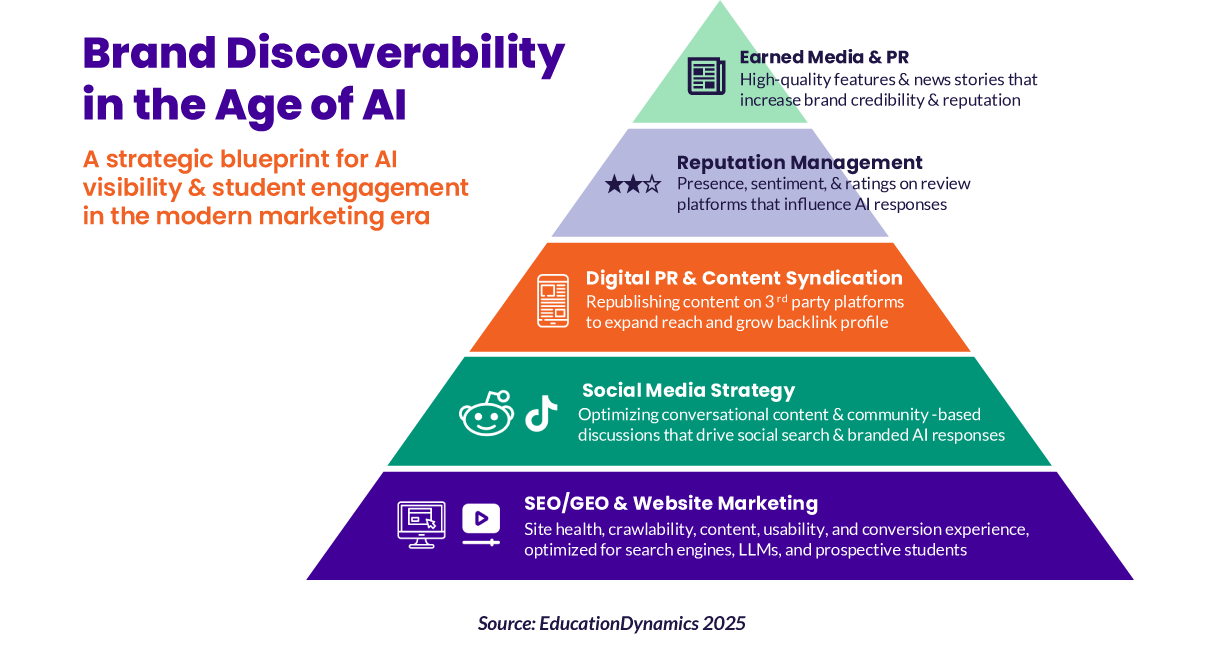
In this environment, content, PR, advertising and enrollment operations can’t operate in isolation. Disconnected efforts dilute AI visibility and waste spend. Institutions that orchestrate these functions around a unified strategy for AI discoverability will be the ones that win attention and intent.
How the Enrollment Cliff Is Exposing Fragile Models
The wave of closures and mergers over the past decade is not random. It is the predictable outcome of models built for a world that no longer exists.
The most vulnerable institutions tend to be heavily tuition dependent, slow to diversify revenue and reluctant to make structural changes even as market conditions shift around them.
Flagship publics and highly endowed privates have more buffer. Many regional and tuition-dependent institutions do not. As demographics tighten and competition increases, legacy models that once felt stable are now under significant strain.
Many of the institutions struggling most today share a common pattern: delayed pivots to online and hybrid delivery, continued reliance on tuition as the primary revenue source and limited attention to Modern Learner expectations around flexibility and cost. Those dynamics are now being tested by the market.
By contrast, institutions that are evolving have accepted that yesterday’s playbook is no longer sufficient. They are actively redesigning their models around revenue diversification, program-market fit and measurable outcomes. They understand that the expectations of Modern Learners have fundamentally changed and that tomorrow’s challenges will not be solved with yesterday’s solutions.
How Student Behavior Is Reshaping Enrollment Strategy
Modern Learner behavior has moved beyond traditional age-based segments. Preferences for online, hybrid and flexible formats cut across generations. Convenience, outcomes and affordability matter just as much to working adults and career switchers as they do to recent high school graduates.
Modern Learners are the architects of their own educational journeys. They don’t wait to be recruited and they don’t stay loyal when processes are rigid and difficult to navigate.
This is especially true for the roughly 43 million Americans with some college and no credential. Many institutions have struggled to reach this audience due to higher acquisition costs, limited capital or an assumption that these learners fall outside their “core” market.
That assumption no longer aligns with how learners actually make decisions. Strategies built for 18–22-year-old residential students do not automatically translate to working adults balancing jobs, family and study. Reaching this audience requires rethinking acquisition channels, messaging, support models and program design.
Institutions that are successfully engaging this segment treat education as a lifelong relationship, not a one-time transaction. They are building pathways for learners to return to upskill and reskill over time, often in partnership with employers, creating recurring value for learners and recurring revenue for the institution.
Attracting traditional students into your institution does not work when it comes to tapping into the 43 million [Americans with] some college, no credential. It’s two completely different things.
Greg Clayton, President, Enrollment Management Services
Why Employer Alignment Now Shapes Reputation and Outcomes
Employer partnerships remain one of the most underleveraged assets in higher education. At the same time, employers consistently report difficulty finding candidates with applied, job-ready skills, particularly as AI reshapes roles and workflows across industries.
That disconnect is not a minor gap. It is a credibility problem. When programs are not aligned with the roles employers are hiring for, institutions are asking students to fund an education the market does not fully value.
High-impact employer partnerships go far beyond tuition discounts and logo swaps. Those are table stakes. The partnerships that move the needle help define the skills and competencies programs should teach, inform curriculum refresh cycles and create structured pathways into internships, apprenticeships and full-time roles.
When job readiness is deliberately designed into every program — including comfort with AI tools and workflows — institutions are better able to prove their value to both learners and employers. That, in turn, strengthens reputation, improves outcomes data and creates new opportunities for sustainable revenue.
What Institutions Are Rebuilding to Compete
Across the sector, a distinct pattern is emerging among institutions that are gaining ground. They aren’t optimizing at the edges. They’re reworking the systems that drive growth.
These institutions treat revenue as mission fuel, not a dirty word. They understand that without sustainable margin, they can’t expand access, invest in innovation or support students at the level the market now expects.
They make ROI explicit — in their marketing, advising and student experience. Cost, convenience and career outcomes are addressed head-on, not buried in fine print. Modern Learners can clearly see how a program connects to specific skills, roles and advancement paths.
Program portfolios are tightly aligned with workforce needs. Curricula are refreshed frequently. Skills and competencies are mapped to real job requirements, not just internal assumptions. Job readiness and AI literacy are integrated into programs, not offered as optional extras.
Brand, marketing and enrollment are orchestrated around AI-driven discovery. These institutions understand that AI is now a primary gateway to information, so they actively manage how they show up in AI overviews and search — not just in traditional rankings and media.
Employer partnerships are deep and operational. Employers help shape programs, provide work-based learning, and validate the skills graduates bring to the table. B2B and workforce channels become meaningful contributors to both impact and revenue.
Institutions design for Modern Learners across ages and life stages. They build flexible pathways, stackable credentials and re-entry points so learners can return to upskill and reskill over time. Education becomes an ongoing relationship, not a one-time transaction.
The common thread is not size, sector or selectivity. It is a willingness to challenge internal inertia, reject the status quo and align every part of the institution with how learners and employers actually behave today. In this market, safety often masquerades as stability — and stagnation carries real risk.
The Decision Facing Higher Ed Leadership
Taken together, these dynamics create a defining choice for higher education leaders: optimize a fading model or rebuild for an AI-powered, skills-driven market. There is no middle ground.
Those that clearly communicate ROI, align programs with workforce demand, build AI into their discovery strategy and use reputation to drive growth will define what comes next.
At EducationDynamics, we’re partnering with leaders ready to make that shift. For a deeper look at how and where to begin, listen to Greg Clayton’s full conversation on the Job Ready podcast.