Why Universities Must Embrace Signal Engineering

The landscape of higher education marketing is undergoing a seismic, structural shift. For the past two decades, enrollment marketers have relied on a predictable, highly trackable sequence: a prospective student enters a keyword into a search engine, clicks a link to an institution’s website, navigates to a program page, and fills out an inquiry form. That linear click-path was the foundation of the traditional enrollment funnel.
Today, that funnel has lost its middle.
As EDDY’s President of Enrollment Management Services, Greg Clayton noted in a recent webinar, “Searches aren’t disappearing, but search behavior, the interface students use, the sources they trust, and even what it means to be visible, are all changing”. Modern learners are now moving through AI-mediated environments that bypass legacy marketing models entirely. To survive and thrive in this new era, universities must stop optimizing for a path their students have stopped taking, and instead adopt a completely new operating system: Signal Engineering.
The Disruption of Student Discovery
The most urgent challenge facing higher education marketers today is that the fundamental nature of digital discovery has changed. Answers are now delivered instantly, meaning prospective students are conducting deep research, evaluating your institution, and making decisions entirely outside of your view.
Consider these staggering shifts in modern search behavior:
- The AI Overview Takeover: As of July 2026, 88% of education-related searches include an AI-generated overview. If your institution’s information is not synthesized directly into those answers, you are effectively invisible to that prospective student.
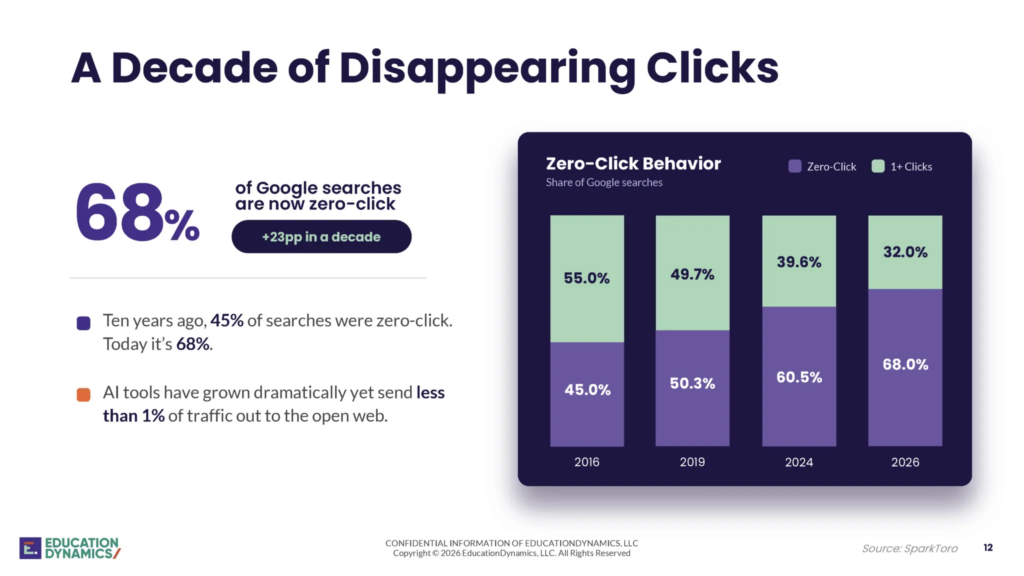
- The Zero-Click Reality: 68% of searches now end without a single click to a website. AI chat assistants and answer engines resolve the user’s query directly on the search results page before a click ever happens.
- The Migration to Social Search: The preferred search bar for a large and growing share of prospective students is no longer Google. Nearly half of Generation Z now prefers social platforms like TikTok, YouTube, or Reddit as their primary search engine.
The Rise of the Stealth Applicant
The clearest evidence that legacy models are breaking down is the exponential rise of the “stealth applicant”—a student who applies without ever appearing in your marketing funnel as an inquiry, without filling out a Request for Information (RFI) form, and without signing up for a campus tour.
The Stealth Applicant Surge
- 9.7% of all applicants now arrive stealth.
- This represents a massive increase of nearly 10x since 2020 (up from just 1%).
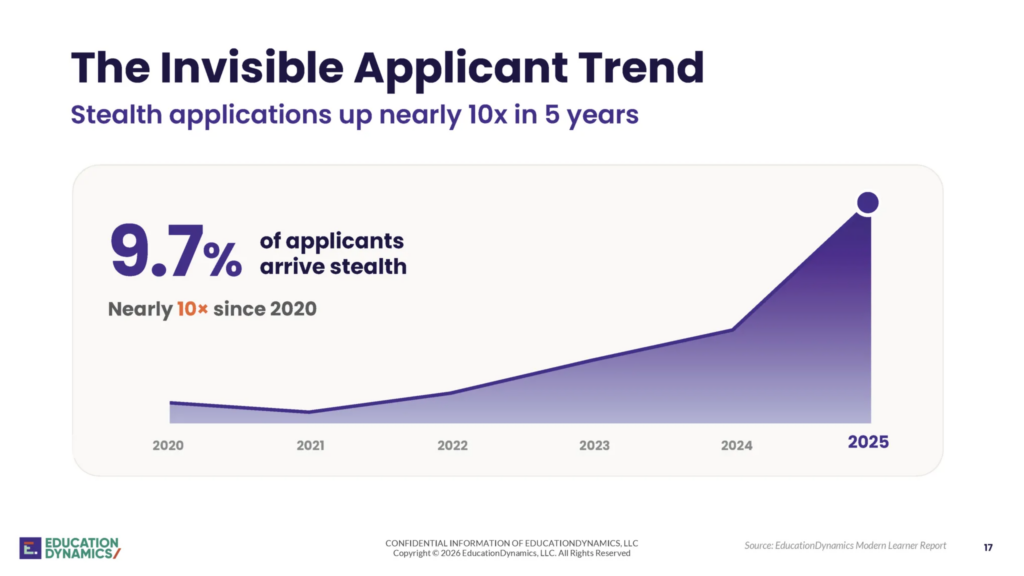
From an operational standpoint, this is a nightmare for traditional attribution models. Your nurture campaigns didn’t touch these students, and your tracking software couldn’t see them. When they finally submit a fully packaged application, whichever channel happened to be their final pathway—usually your direct website—gets 100% of the credit. This gives marketing teams a false reading of what is actually driving enrollment, obscuring the critical off-site discovery journey.
What is Signal Engineering?
AI systems are maturing faster than most universities can adapt. AI models do not operate within the boundaries of your internal organizational structure; they synthesize all the data your brand creates across every digital surface.
These distinct data points are “signals.” If your internal teams are fragmented, the signals your brand produces will be fragmented. And when signals are fragmented, the AI algorithm will simply award the ultimate citation to a competing institution with a more coherent digital footprint.
Signal Engineering is the intentional practice of architecting the signals your institution creates—and that AI ingests—so modern learners can find you, trust you, and choose you.
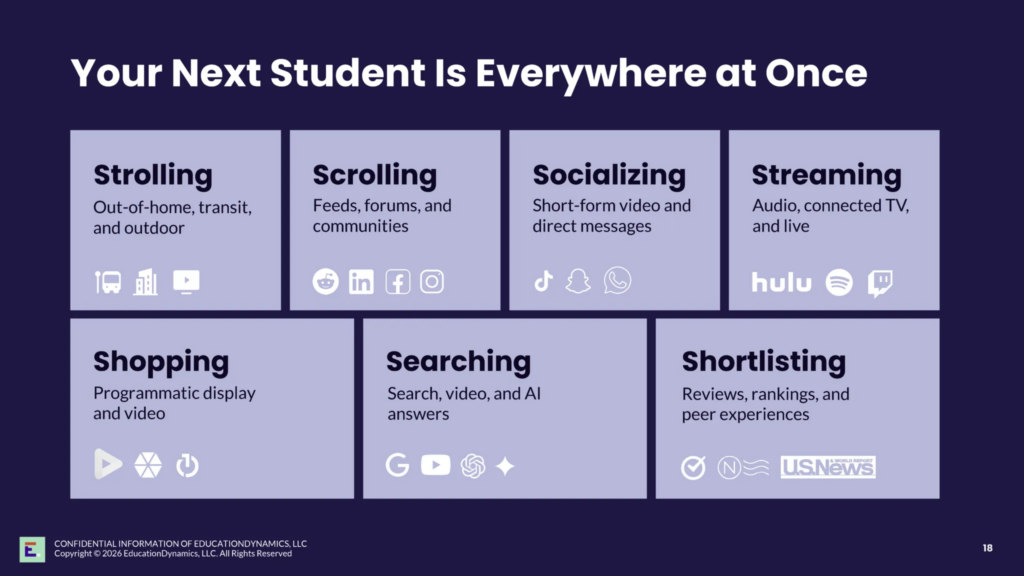
Your Next Student is Everywhere at Once
To understand the scope of the signals AI is evaluating, you must look beyond your website. Your brand’s footprint spans a massive, interconnected ecosystem:
- Out-of-home, transit, and outdoor advertising
- Feeds, forums, and online communities
- Short-form video and direct messages
- Audio, connected TV, and live streaming
- Programmatic display and video
- Search, video, and AI answers
- Reviews, rankings, and peer experiences
Signal Engineering is not simply a new marketing channel you need to expand into, nor does it replace the tactical work your teams are already executing. Instead, as EDDY’s Sarah Russell explains, “What changes is the connective tissue between channels. A shared language across teams so that visibility means the same thing in your paid media meeting as it does in the comms meeting.”
It is a system designed to make brand awareness and performance marketing work together as a single, compounding force.
The Seen, Trusted, Chosen Framework
To properly engineer this ecosystem, universities must organize their efforts around three essential brand outcomes: Seen, Trusted, and Chosen. These are not isolated goals; they are an interconnected system.
1. SEEN (The Visibility Layer)
Search has fundamentally become answer driven. Being “Seen” is the critical work of ensuring your institution surfaces in a fragmented landscape where AI Overviews resolve queries instantly. Because modern student research behavior has shifted to become highly brand-first, you must establish visibility long before the traditional search journey begins. If you are not discoverable in those AI answers, you simply do not exist to that student.
2. TRUSTED (The Credibility Layer)
When a student ultimately encounters your brand across these various surfaces, the information must be consistent, resonant, and authoritative. In the AI era, reputation is machine-read. Reviews, third-party mentions, Reddit threads, and structured data form the foundational signal layer that Large Language Models (LLMs) train on. These platforms provide AI systems with the credible citation sources necessary to validate your institution’s messaging.
3. CHOSEN (The Conversion Layer)
A website visit is no longer an early indicator of intent; it is now a deep-funnel event. You cannot simply buy your way to this stage if your “Seen” and “Trusted” layers are thin. The “Chosen” layer is where your brand reputation meets the final enrollment decision.
This conversion layer encompasses:
- Website marketing and UX/CRO (Conversion Rate Optimization)
- Paid search and paid social
- Inquiry generation
- Lead nurturing
- The application experience
“These three outcomes function as a system. Seen creates the conditions for Trusted. Trusted makes Chosen more efficient. And Chosen, when you do it well, generates the stories and reviews and signals that feed right back into Seen.” — Sarah Russell
Planning From the Top Down
A major roadblock for large universities is that marketing teams typically plan from the bottom up: the paid search team gets a budget, the web team gets a project list, and the social team gets a content calendar.
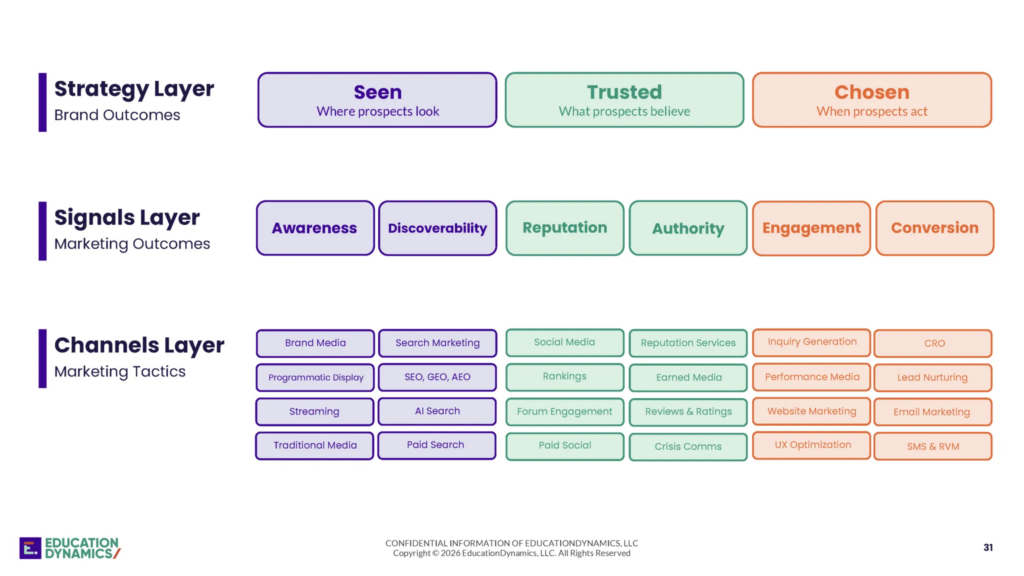
Signal Engineering flips this model, requiring a top-down approach divided into three distinct layers to unify your practices:
| The Hierarchy Level | What It Encompasses | How to Use It |
| 1. The Strategy Layer | Your brand outcomes: Seen, Trusted, and Chosen. | Start here to define your overarching institutional goals. |
| 2. The Signals Layer | Your marketing outcomes: Awareness, discoverability, reputation, authority, engagement, and conversion. | Use this layer to create a shared vocabulary. When PR and Paid Media both focus on “discoverability,” you break down departmental silos. |
| 3. The Channels Layer | Your actual tactical execution (website, SEO, PR, social media). | Every touchpoint in these channels must generate signals that feed AI surfaces to support the top-level Strategy. |
Three Tangible Moves to Build Your Signal Ecosystem
Transitioning to this new operating system requires an honest assessment of your current signal maturity, but you can start taking action immediately. Sarah Russell recommends three representative shifts in focus that do not require an immediate budget overhaul or departmental reorganization:
1. Audit Your AI Visibility Baseline: You cannot fix what you cannot see. Many institutions are completely blind to their AI discoverability rates. Start by establishing a baseline understanding of how frequently your brand is cited versus just mentioned.
- The Action: Run a robust, categorized set of 10 to 15 incognito prompts against ChatGPT and Gemini that accurately reflect what a prospective student would ask (e.g., queries about specific programs, affordability, or audience-based questions).
- The Upgrade: If resources allow, utilize AI visibility tools like Semrush, Profound, or Ahrefs to index your visibility more accurately.
2. Treat Brand and Reputation as Vital Infrastructure: Because AI models rely heavily on third-party data to determine credibility, your off-site reputation is now foundational infrastructure. The videos you produce, the Reddit threads about your dorms, and your peer reviews are actively feeding LLM models.
- The Action: Apply the exact same level of rigor, ownership, and accountability to managing these trust-building channels as you currently do for your inquiry-generating lead forms.
3. Socialize a Shared Vocabulary: The fragmentation of brand signals usually stems from a fragmentation of internal communication.
- The Action: Develop a universal standard for how all your teams measure effectiveness. By repositioning internal conversations around the shared outcomes of being Seen, Trusted, and Chosen, you will naturally begin to dismantle the silos separating your channel teams.
Watch the Full Webinar On-Demand
Want to dive deeper into the data and framework discussed above? You can now watch the complete recording of “Signal Engineering: How universities get seen, trusted, and chosen in the AI search era” featuring EDDY’s Greg Clayton and Sarah Russell. The full on-demand session covers these topics in detail and provides a comprehensive look at the shift in modern student behavior.
Take the Next Step: Join the Signal Engineering Masterclass
“We don’t just react to change, we predict it,” says Greg Clayton, highlighting EDDY’s decades of experience navigating major disruptions in student behavior.
If your institution is ready to stop reacting to the AI search disruption and start engineering your discoverability, EducationDynamics is hosting a comprehensive Signal Engineering Masterclass. Led by Sarah Russell, this masterclass will dive deeper into advanced AI measurability, citation rates, and how to build a highly effective, tailored visibility strategy for your specific programs.